
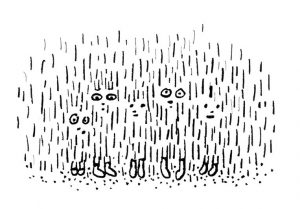
In this bleak weather, it is very tempting to stay indoors with the children building a Lego tower and, go on then, watching a film too.
But are you doing more harm than good? Three in ten children never play outside, or only once a week, according to a survey by research agency Kantar commissioned by the Dutch children’s charity Jantje Beton. Only 14 percent of children between 6 and 12 play outside every day; five years ago that was still 20 percent. Do we keep our children indoors too much? And aren’t freezing cold and rain just a feeble excuse?
What do the experts say?
Playing outside is good for a child’s cognitive, physical and emotional development. Researchers from the universities of Leiden and Lisbon studied children in the school playground and saw that when children get the chance to play freely, they are better at resolving conflicts and recognising emotions in their playmates. ‘They become more social,’ says educational psychologist Louise Berkhout.
But it is precisely free play in the open air that is being squeezed out, Berkhout believes. ‘We no longer simply let children get on with it. Parents and teachers are afraid something will happen to them.’ For her PhD research at the University of Groningen, Berkhout studied 47 kindergarten classes at twenty schools while they played. Video recordings show that children often only become fully absorbed in their play after twenty minutes. ‘If you give them ten minutes, or hover over them, real play rarely develops.’
Even better than a classic playground is the woods or a piece of wasteland in the city. ‘By dragging branches around or building something themselves, they explore their physical abilities. These are sensory, physical experiences you don’t learn indoors from an app.’
Why do children actually play outside so little? It is easy to blame the TV or tablet screen. But according to experts, the problem lies with the attitude of parents. ‘It starts with realising how important it is to go outside,’ says educationalist Annet Weterings, author of a Dutch book on experiencing nature in childcare, Horen en zien, ruiken, voelen, proeven. ‘Indoor children? They don’t exist. Mum and dad’s behaviour sets the example, so if you say: ugh, rain, your child will copy that. And young children are of course dependent on their parents, who need to make time.’
How much time, then? The Dutch guideline for healthy exercise for people under 18 is at least one hour a day. 80 percent of children do not meet that standard. Caroline Klaver, professor of ophthalmology at Erasmus Medical Centre in Rotterdam, advised in the newspaper NRC Handelsblad to play outside for two hours every day to protect children’s eyes. Short-sightedness is increasing sharply because children look at screens so much that there is too little variation with looking into the distance.
So how should it be done?
‘There is no such thing as bad weather, only bad clothing,’ says Annet Weterings. In a good snowsuit, rainwear and boots, a child can actually always go outside. Parents sometimes feel sorry for them or think their little ones will get ill. ‘Quite the opposite. By being outside a lot, they build up better resistance,’ says Weterings. At many Scandinavian day-care centres, children even nap outside in special shelters, and this is also done at Dutch day-care centres.
Of course it takes some persuasion to get a child excited about going out into the cold or rain. ‘We’re going for a walk’ won’t make them happy straight away. ‘Make it exciting. Suggest going on a treasure hunt or looking for animals,’ says Weterings. ‘Take a magnifying glass and a plastic bag to collect stones and conkers.’
There is a good chance that mums and dads will discover that going outside isn’t such a hassle after all. Yes, squeezing those little limbs into shoes and gloves takes a bit of effort, but once out in the fresh air your child is no trouble at all. The entertainment is there for the taking, for free. And you can sit back for a change too.
Source: De Volkskrant
Samen afspraken maken over schermtijd?
Met Mytimingcards krijgt je kind duidelijkheid en eigen verantwoordelijkheid: 24 tijdskaarten, 4 bonuskaarten, een timer en het Mytimingcardscontract.