
Child psychologist Tischa Neve gives ten tips on how to go about it.
1. Good preparation
Good preparation is half the battle. For example, go through the week together every Sunday evening: what is on the schedule, who does what and how will the logistics work? The same goes for the rest of the week: lay out whatever you can in advance, cook for two days at once and pack the school bags the evening before. It makes such a difference!
2. Plan and organise smartly
Write things that need doing straight onto a calendar and keep a running shopping list. Group activities such as ironing, paperwork and chores into one planned part of the day instead of doing a little bit all the time. Above all, guard your own diary and that of the children. Plan in enough moments of rest; that makes everyone happy.
3. Routines
Routines for the recurring everyday things at home provide clarity, regularity, something to hold on to and calm. A fixed order for the morning and evening routine prevents a whole lot of hassle.
4. Basic agreements
Sweets, TV or computer, bedtimes, savoury or sweet sandwich toppings, homework and playing: it can cause quite a bit of unrest at home. Fixed basic agreements about these kinds of recurring battles create clarity and far fewer arguments. Simply because a child knows what the agreement is. Exceptions you simply call exceptions.
5. Take your time
‘Hurry up….’ ‘Come on, we’re going to be late’. How often do we hear ourselves say that. I really can’t give a better tip than simply taking a bit more time for everything that needs to be done. Start on time, get up a bit earlier and go upstairs on time. Simple and effective, if only we actually do it.
6. Choose your battles
You can get worked up about everything, or you can choose not to. It has helped me enormously since I started letting go of a lot. Just do some things yourself, don’t make an issue of everything and stick to the things that really matter.
7. Lower the bar a little
Believe me: no family is always cosy, and no child or parent is always friendly and relaxed. That is impossible and it doesn’t have to be that way. No energy left today? Then the house can be tidier tomorrow. Everyone exhausted and grumpy? Cancel a few plans and have a movie afternoon. Don’t ask too much of yourself or your children. We are all only human.
8. Make things easier for yourself and the kids
On hectic days, choose food the kids like. On a tough day, simply blend the pasta sauce to avoid moaning. And in busy weeks, order your groceries online for once, to name just a few things.
9. Making ‘mistakes’ is allowed
Fortunately, there is no such thing as perfect parenting. Or a perfect parent. The occasional parenting slip-up is part of it; everyone makes them, and they are actually fine for children growing up. Imagine having a perfect parent: deadly dull, and as a child you would miss out on lots of valuable life lessons and learning moments.
10. Attention at moments of transition
Moments of transition often lead to whining or rebellious children. Many children find these moments difficult. They can’t oversee what is happening, find it hard to finish what they are doing or need to get used to the new situation. It is nice, and smart, to give your children some time and attention at moments like these. Real time and attention.
You will find these tips and lots more inspiration for more fun and easier parenting from child psychologist Tischa Neve in her latest book ‘Inspiratieboek voor leuker en makkelijker opvoeden’ (in Dutch).
Source: JM Ouders
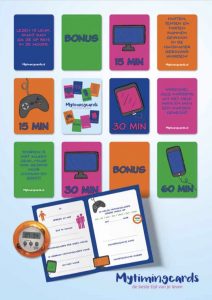
Samen afspraken maken over schermtijd?
Met Mytimingcards krijgt je kind duidelijkheid en eigen verantwoordelijkheid: 24 tijdskaarten, 4 bonuskaarten, een timer en het Mytimingcardscontract.